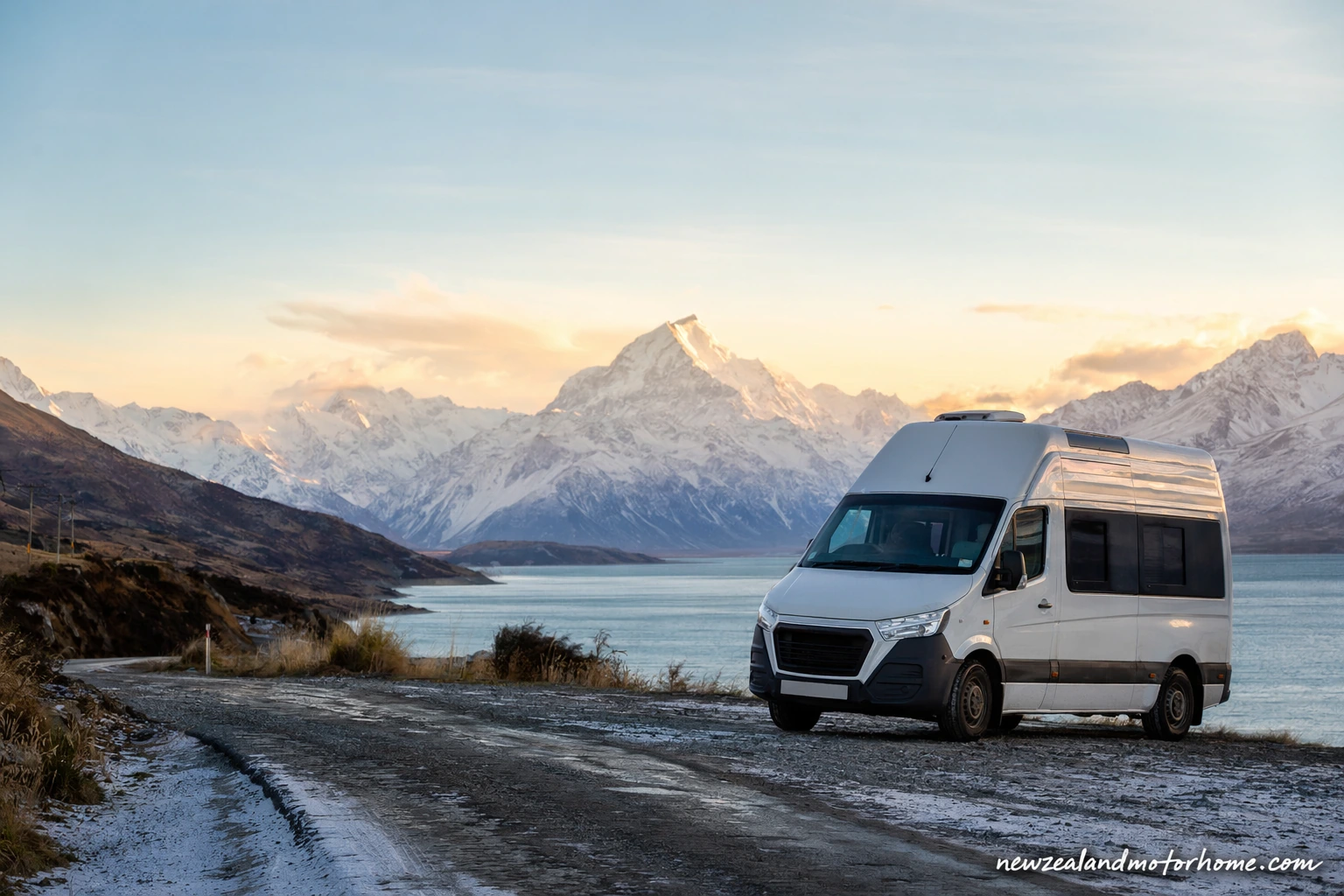
Taking a campervan in winter new zealand without the guesswork
- Best season: June to August
- Allow slower driving days
- Powered sites recommended
- Check chains and road warnings
- Self-containment rules still apply
Winter changes the rhythm of a New Zealand motorhome holiday. The days are shorter, the light is clearer, the campsites are quieter, and a powered site with a good heater can feel like the best decision of the day.
This guide is for travellers driving and sleeping in their own hired campervan or motorhome, not dipping in and out by car. We’ll cover where winter works well, how to choose overnight stops, what to think about for LPG, water and dump stations, and how to keep your route flexible when frost, snow or high winds affect the road ahead.
Why winter works well in a campervan
A winter campervan trip is less about covering every famous viewpoint and more about travelling steadily, parking well, and enjoying the space between places. Popular lakeside and coastal stops are often quieter, holiday parks usually have more powered-site availability outside school holidays, and you can build evenings around hot showers, drying rooms and a warm van.
The trade-off is that you need to plan your day earlier. Sunset comes quickly, temperatures can drop hard after 4 pm in inland areas, and some scenic roads are slower than they look on a map. In a motorhome, arriving in daylight matters: you want time to level the van, plug into power, refill water if needed and check where the amenities block is before it gets icy underfoot.
- Best comfort choice: powered sites every few nights, or nightly in colder inland regions.
- Good winter regions: Northland, Coromandel, Bay of Plenty, Hawke’s Bay, Nelson Tasman, Marlborough, West Coast and Canterbury coast.
- Colder but rewarding regions: Taupō, Central Plateau, Mackenzie Country, Central Otago and Queenstown Lakes.
- Watch-outs: black ice, chain requirements, limited daylight, closed alpine side roads and condensation inside the van.
Choosing a winter route that suits the van
In winter, the best route is one with options. Coastal roads are generally milder, while inland highways can be beautiful but frosty. If you are driving a longer motorhome, allow extra time for hill climbs, narrow bridge approaches and pull-offs that may be snow-banked or muddy after bad weather.
For a first winter trip, consider linking warm bases rather than chasing a tight loop. In the North Island, Auckland to Rotorua, Taupō, Napier and Wellington gives geothermal stops, lake views and serviced holiday parks. In the South Island, Christchurch to Kaikōura, Nelson Tasman and the West Coast keeps you mostly lower-level, while a Christchurch–Tekapo–Wānaka–Queenstown route is spectacular but needs closer attention to frost, snow and alpine-pass forecasts.
If you want someone to sanity-check your winter distances, overnight stops and vehicle size against the season, you can use the talk-to-us trip planning step before locking everything in.
- Build short driving days: winter scenery is slower, and stops for photos, chains or weather checks take time.
- Keep a low-altitude Plan B: especially around the Lindis Pass, Crown Range, Desert Road, Arthur’s Pass, Porters Pass and Lewis Pass.
- Avoid late arrivals: reverse, plug in and refill water while it is still light.
- Check your van height: low branches, covered parking and older service-station canopies can be tighter in small towns.
Powered sites, freedom camping and winter overnights
Winter is when powered sites earn their keep. A powered pitch lets you run the van’s approved heating system more comfortably, charge devices, use campsite kitchens and dry wet jackets without relying only on your house battery. If you are parked beside a lake or in a valley, expect the temperature to fall faster than it does in town.
Freedom camping can still be part of a winter trip, but only where it is allowed and only if your vehicle meets the current self-containment requirements. Many councils restrict overnight parking near lakes, beaches and town centres, and some places that feel empty in winter are still patrolled. Always read the local sign at the actual parking area, not just an app listing.
- Use holiday parks after big weather days: hot showers, laundry and powered heating make a real difference.
- Choose firm ground: avoid grassy corners that may turn boggy overnight.
- Park nose-out if snow or frost is possible: it makes an early departure easier.
- Do not block snow-clearing areas: alpine village car parks and ski access roads may need room for ploughs.
- Keep windows cracked slightly: controlled ventilation helps reduce condensation inside the sleeping area.
Water, LPG, batteries and dump stations in cold weather
Cold weather changes your van routine. You will probably use more LPG for cooking, hot water and heating, and your house battery can drain faster when lights, fans and charging are used for longer evenings. Before heading into quieter areas, top up fresh water, empty grey and toilet tanks, and check how much LPG you have left.
Dump stations are widely available in New Zealand, but in winter you do not want to be hunting for one after dark or discovering a rural station is awkward for your vehicle length. Use serviced holiday parks, public dump stations and larger-town facilities as part of your route rhythm. Treat fresh water the same way: refill when it is easy, not when the gauge is already low.
- LPG: check bottle levels before cold inland legs, especially around the Central Plateau, Mackenzie Country and Central Otago.
- Fresh water: refill during the day; hoses and taps can be unpleasant to handle in freezing conditions.
- Grey water: empty regularly so you are not carrying unnecessary weight over hills.
- Toilet cassette: do not leave it until the morning of a long drive; dump when a clean facility is available.
- Battery: powered sites help if you are staying put for two nights in cold, cloudy weather.
Driving safely on winter New Zealand roads
Winter driving in a campervan is about patience. A motorhome is heavier and higher than a car, with longer braking distances and more windage on exposed bridges and lake roads. Frost can sit in shaded corners long after the rest of the highway looks dry, and black ice is most likely early morning, late afternoon and in valley floors.
Snow chains may be required on some alpine roads, and not every rental vehicle is allowed on every ski-field access road. Check your hire agreement before committing to gravel, steep or chain-controlled routes. Often the easier plan is to park the van in town on a legal day park, use local transport to the ski area, and come back to a powered site for the night.
- Delay your start: let frost lift before driving shaded passes.
- Use pull-over bays: let faster traffic pass; do not rush a heavy van downhill.
- Watch wind warnings: high-sided motorhomes can feel exposed on open plains and harbour bridges.
- Fuel earlier than usual: small-town opening hours can be shorter in winter.
- Keep boots accessible: you may need to step out on slush, gravel or frosty ground when connecting power or checking the site.
What to pack and how to live well in the van
A warm winter van trip is partly about packing the right small things. Bring layers you can dry easily, a beanie for evening walks to the amenities block, and footwear that can handle wet grass around campsites. Inside the van, keep damp gear away from bedding and use campsite drying rooms whenever you can.
For sleeping, ask what bedding is supplied with your hired campervan and whether extra blankets are available. Even with good heating, you may not want to run it all night, so warm sleepwear and easy ventilation help. In the morning, wipe condensation from windows before it drips into blinds, cupboards or bedding.
- Useful extras: head torch, gloves, quick-dry towel, warm socks and a soft bag for damp shoes.
- Food planning: keep an easy dinner in the van for nights when arriving late or cooking outside is miserable.
- Van routine: crack vents, dry surfaces, charge devices while on power and stow loose items before frosty roads.
- Comfort stop: book powered sites in colder towns rather than relying on a remote unpowered bay every night.
Keep planning
Campervan new zealand in september
Read onCampervan new zealand in october
Read onCampervan new zealand in november
Read onCampervan new zealand in may
Read onCampervan new zealand in march
Read onCampervan new zealand in june
Read onCommon questions
Is it a good idea to hire a campervan in New Zealand in winter?
Yes, if you plan around shorter daylight, colder nights and occasional weather changes. Winter suits travellers who like quieter campsites, flexible routes and powered holiday parks rather than a fast, tightly packed itinerary.
Do I need a self-contained campervan for winter travel?
If you want to use freedom camping areas, your vehicle must meet the applicable self-containment rules and you still need to follow local signs. Even with a certified van, many winter travellers mix freedom camping with powered holiday park nights for warmth, showers and laundry.
Can I drive a motorhome to ski fields in New Zealand?
Sometimes, but check your hire agreement and the ski-area road conditions first. Many ski-field roads are steep, icy, gravel or chain-controlled, so it can be easier to park the van in town and use approved local transport up the mountain.
Will water tanks or pipes freeze in a campervan?
In most common touring areas it is manageable, but hard frosts can affect hoses, taps and exposed fittings. Refill water during the day, avoid letting tanks run low in remote cold areas, and use powered sites when temperatures are forecast to drop well below zero.
Are campsites open in winter?
Many holiday parks and some DOC-style camps remain open, but seasonal closures do happen, especially in alpine or remote areas. Check your overnight stop before you drive there, and arrive early enough to find another legal option if conditions change.
How many hours should I drive each day in winter?
For a comfortable campervan trip, plan shorter days than you would in summer. Around three to four hours of actual driving often feels full once you add weather checks, slower roads, dump-station stops, groceries, photos and setting up the van before dark.
Have a planner shape this for your dates
Send a short outline — your dates, party size, and the kind of trip you want. A planner replies with a vehicle recommendation, a paced route, and the realistic budget.